English
 Türkçe
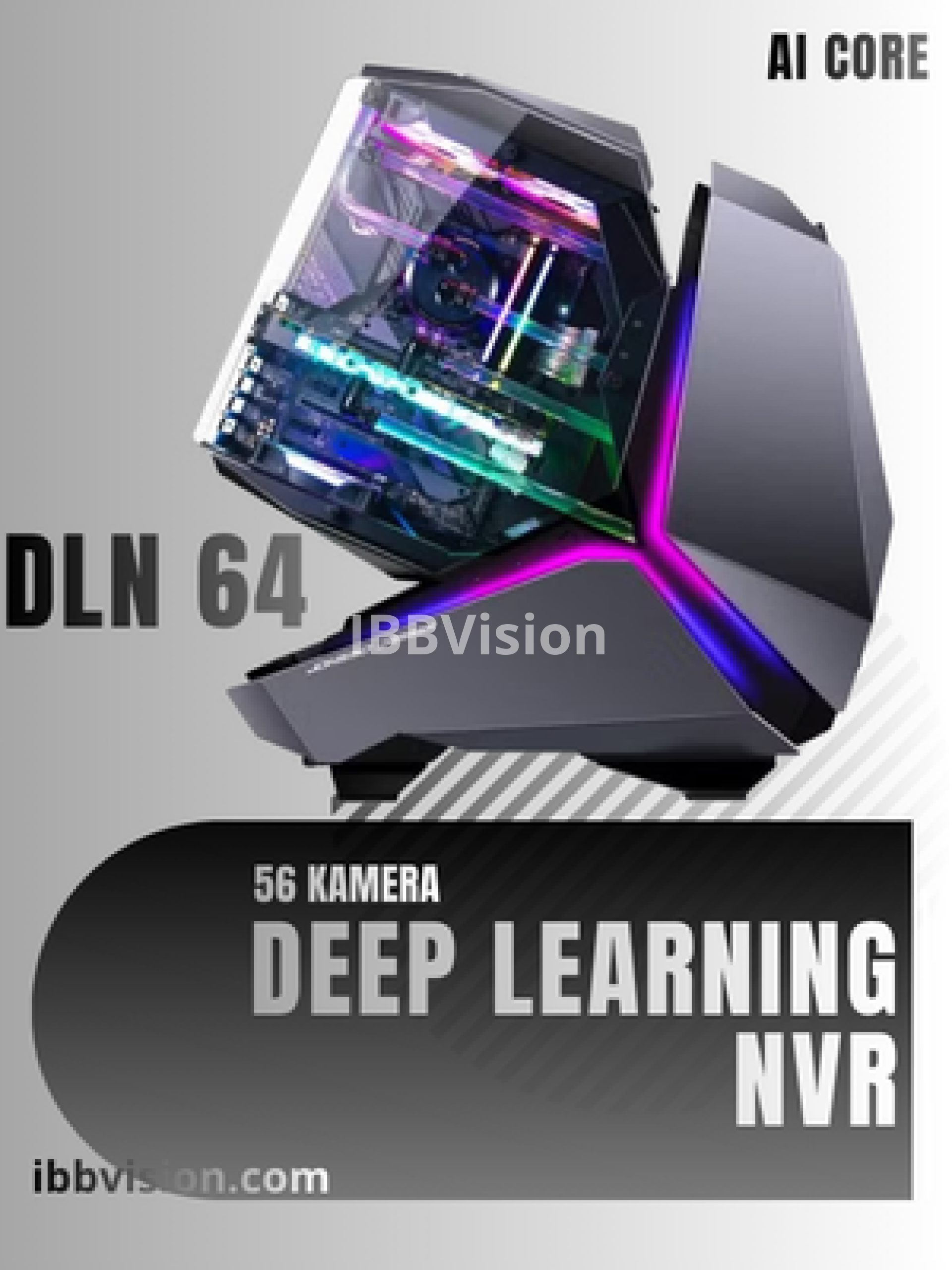
IBBVision DLN 64 — AI-Powered Enterprise NVR and Video Analytics Platform
IBBVision DLN 64 is designed as an AI-based video analytics platform that goes beyond conventional NVR systems, transforming from a device that merely records video into a system that processes visual data captured from the field, analyzes it, and converts it into operational value. While analyzing live camera streams in real time, the system also examines historical video recordings using AI-based scanning techniques without the need for manual playback, accelerating post-incident analysis processes and reducing human dependency.
IBBVision DLN 64 provides a high-capacity, scalable, and security-focused analytics infrastructure for corporate facilities, public spaces, production sites, large-scale campuses, and critical infrastructure environments.
64-Channel IP Camera Support and Parallel Processing Architecture
The system processes and stores streams from up to 64 IP cameras simultaneously. Each camera is assigned an independent analysis queue, and CPU/GPU resources are allocated on a per-camera basis. Thanks to the parallel AI inference infrastructure, adaptive frame processing is applied in high-density scenes, minimizing latency. As a result, analytics workflows remain uninterrupted, alarm generation is not delayed, and recording continuity is preserved.
Real-Time AI-Based Video Analytics
Each camera runs an independent analytics engine supporting capabilities such as object detection and classification; human, vehicle, and face analytics; multi-target tracking; identity-based person tracking; zone intrusion and line-crossing detection; crowding and density analysis; and occupational safety–oriented violation detection.
The analytics engine can dynamically switch between low-latency, accuracy-focused, or resource-efficient operating modes based on scene density and the current state of system resources.
AI Analysis on Historical Recordings (Retrospective AI)
IBBVision DLN 64 is not limited to live video analytics; it also performs AI-based scanning on historical video recordings. Users can retrospectively query where and how many times a specific person appeared, which cameras a particular vehicle passed through, or where a face was detected within specific time intervals.
Instead of reprocessing archived footage from scratch, the system utilizes feature vectors generated during recording. This vector-based search approach accelerates post-incident investigations, enables direct access to critical moments, and significantly reduces the need for manual video review.
Multi-Layer Security and Behavior Analytics
Within its core model package, the system supports a wide range of object and alarm classes under security analytics, occupational health and safety, and area utilization analytics. These include suspicious object and abandoned item detection; recognition of abnormal behaviors such as running or fighting; unauthorized area access; personal protective equipment detection; risky movement recognition; vehicle–pedestrian classification; reverse-direction movement detection; and crowd/queue analysis.
The alarm generation layer evaluates events by camera, time, and zone, prioritizes alarms based on severity scores, and can trigger automated recording workflows when required.
Custom Model Development and Institutional Integration
IBBVision DLN 64 allows the integration of up to 20 custom AI models tailored to the specific risks and operational needs of different institutions and sectors. Institution-specific scenarios—such as surface deformations in municipal environments, incorrect part placement on production lines, hazardous area approaches in energy sites, or suspicious package types in shopping malls—can be incorporated into the system.
The model lifecycle includes data sampling, label validation, edge-oriented model compilation, and continuous monitoring of performance metrics. Models are integrated into the platform using version-controlled deployment.
ROI (Region of Interest)–Based Prioritization
By defining regions of interest for each camera, analysis frequency can be increased in critical areas while computational load is reduced in non-essential regions. This approach balances resource consumption, lowers false alarm rates, and enhances the effectiveness of security coverage in critical zones.
Alarm and Incident Management Layer
Alarms generated by the system are supported by visual overlays, real-time on-screen operator notifications, audible alerts, automatic event recording, and rapid access to incident moments (rewind and jump-to-event functionality). Alarm flows are prioritized by severity score, tasks can be assigned among operators, and alarm histories can be reported.
Reporting and Analytics Monitoring Dashboard
IBBVision DLN 64 does more than store recordings; it generates meaningful data for security and operations teams. Event and alarm distributions, detection accuracy rates, camera-level analytics intensity, model performance metrics, and scene-based risk maps can be monitored through the system.
These insights are used as decision-support mechanisms for preventive security planning, camera placement optimization, and workforce planning processes.
Technical Architecture and Processing Pipeline
The system architecture consists of RTSP stream ingestion, transfer to time-stamped frame queues, execution of a parallel AI inference pipeline, object and behavior analysis, generation and storage of embedding data alongside metadata, and concurrent operation of the alarm engine.
The infrastructure supports a multi-process inference architecture, camera-level CPU/GPU resource allocation, parallel queue processing, runtime model selection management, and latency-focused adaptive frame processing.
Integration and Compatibility
The system provides full RTSP compatibility with IP cameras from all manufacturers. It can integrate with third-party VMS and CMS solutions and supports REST-based service outputs as well as webhook-based alarm integrations.
Application Areas
Corporate campuses and large-scale facilities, municipal and public spaces, multi-entrance buildings and shopping malls, production and quality control lines, energy sites, and critical infrastructure environments are among the primary application areas targeted by IBBVision DLN 64.
| Shop Location |