English
 Türkçe
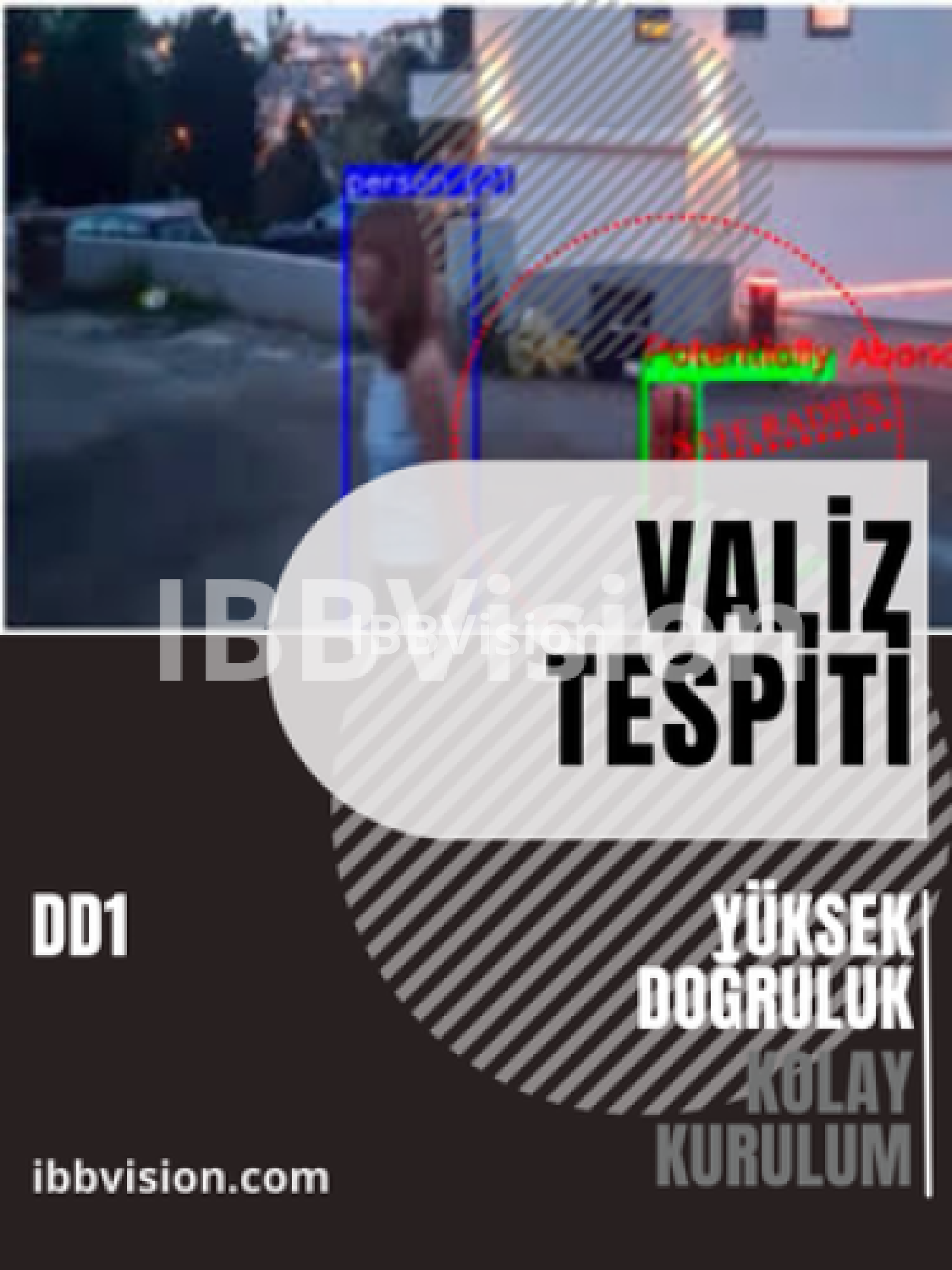
IBBVision AI Suspicious Bag Detection
Suspicious Bag Detection is an AI-powered analysis module that analyzes security camera footage in real time and automatically detects objects such as bags, suitcases, packages, and similar items that have been left unattended, abandoned, or forgotten in an area. This module is also referred to as "Abandoned Object Detection" or "Unattended Item Detection."
This module continuously monitors and analyzes objects within the camera's field of view. It detects when an object is left by a person, that person subsequently moves away from the object, and the object remains stationary for a specified period of time. This situation is assessed as a potential security threat, and the system immediately generates an alarm.
What Situations Does It Detect?
The Suspicious Bag Detection module can detect the following situations and scenarios:
1. Abandoned Objects:
-
Unattended Bags: A person leaving their bag or suitcase behind and walking away. This poses a security risk, especially in crowded areas such as airports, train stations, and shopping malls.
-
Forgotten Items: Items left absentmindedly by a person and not retrieved. These may include wallets, backpacks, shopping bags, and similar objects.
-
Suspicious Packages and Boxes: Packages, parcels, backpacks, briefcases, and similar objects that have no apparent owner and are not claimed by anyone. Such items are prioritized as they may pose a security threat.
-
Objects Remaining Stationary for Extended Periods: Objects that do not move for a specified duration (e.g., 5–10 minutes) and have no one nearby.
2. Unattended Object Behaviors:
-
Placement and Departure: A person placing an object on the ground and then moving away from it. This behavior is the most apparent indicator that an object has been abandoned.
-
Increasing Distance Between Object and Owner: The distance between a person and their belonging gradually increasing. As the person moves away, the object is classified as "abandoned."
-
Unattended Item: An object with no one in its vicinity for an extended period.
3. Risky Situations Encountered in Public Areas:
-
Unattended Items in High-Traffic Areas: Suspicious objects left in crowded locations such as bus stops and metro entrances.
-
Event and Festival Areas: Suspicious items left at mass gatherings such as concerts, festivals, and rallies.
-
Near Critical Infrastructure: Objects left close to sensitive areas such as government buildings, embassies, and energy facilities.
How Does It Work?
The Suspicious Bag Detection module utilizes deep learning and video analysis technologies. The system operates according to the following stages:
-
Object Tracking and Recognition: The system detects and classifies all objects (people, bags, suitcases, packages, etc.) in the camera image. Each object is labeled with a unique identifier, and its movements are tracked.
-
Motion and Location Analysis: The system continuously analyzes whether each object is moving and how long it has remained in the same location. Objects that remain stationary are flagged as potential "suspicious" candidates.
-
Owner-Object Relationship Analysis: When an object remains stationary, the system attempts to identify the person who left it. When that person moves away from the object and the object remains stationary for a specified period, it is classified as "abandoned."
-
Timeout Check: When an object remains stationary for a specified duration (e.g., 30 seconds, 1 minute, or 5 minutes) and its owner is not nearby, the system evaluates it as "suspicious." This duration is user-configurable.
-
Alarm and Notification: When a suspicious object is detected, the system automatically generates an alarm. The moment of the event is recorded, and security personnel are notified immediately.
Where Is It Used?
Suspicious Bag Detection is used particularly in areas where security is critical and crowds are dense:
1. Transportation Hubs:
-
Airports: Terminal entrances, waiting lounges, baggage claim areas. These are among the most critical areas for detecting abandoned suitcases and bags.
-
Train and Metro Stations: Platforms, waiting areas, and areas in front of ticket counters.
-
Bus Terminals and Stops: Areas with high passenger traffic.
-
Ports and Piers: Ship terminals and passenger waiting lounges.
2. Public Spaces and Gathering Places:
-
Shopping Malls: Entrances, corridors, food courts, and seating areas.
-
Museums and Exhibition Halls: Exhibition areas and entry/exit points.
-
Concert and Festival Areas: Zones with high participant traffic.
-
Sports Stadiums: Stand entrances, corridors, and waiting areas.
-
Parks and Squares: Detection of abandoned objects in open areas.
3. Corporate and Commercial Areas:
-
Corporate Buildings: Entrances, lobbies, and visitor waiting areas.
-
Banks and Financial Institutions: Customer waiting areas and ATM zones.
-
Hotels and Accommodation Facilities: Reception areas, lounges, and foyers.
4. Educational and Healthcare Institutions:
-
Schools and Campuses: Entrances, corridors, cafeterias, and libraries.
-
Hospitals: Emergency room waiting areas, entrances, and corridors.
5. Critical Infrastructure and Government Buildings:
-
Public Buildings and Municipalities: Visitor entrances and waiting halls.
-
Courthouses and Courts: Entrances and waiting areas.
-
Energy Facilities: Entry points and perimeter fencing.
Advantages Provided
-
Preventive Security: An abandoned bag or package could potentially contain explosives or pose another threat. This module detects suspicious objects at an early stage, enabling security teams to take preventive action before an incident occurs.
-
Rapid Intervention: The system alerts security personnel as soon as a suspicious object is detected. Security teams can be quickly dispatched to the location of the object. In areas such as airports and stations, rapid intervention is critically important.
-
Uninterrupted 24/7 Surveillance: Unlike human operators, the system operates continuously without fatigue or distraction. It remains actively monitoring during peak hours, at night, or when staffing levels are low.
-
Low False Alarm Rate: Advanced AI algorithms successfully distinguish between temporarily placed items (e.g., a bag briefly set down by a person) and genuinely abandoned objects. The false alarm rate is kept to a minimum.
-
Automatic Recording and Evidence Preservation: All suspicious object events are automatically recorded. The exact time, location, footage, and duration of the event are logged. These records can be used as evidence for post-incident review, investigation, and legal proceedings.
-
Reduced Personnel Workload: It is practically impossible for security personnel to continuously monitor dozens of screens. The system automatically detects suspicious objects, allowing personnel to focus solely on genuine incidents. This increases workforce efficiency.
-
Protection of Institutional Reputation: Early detection and prevention of security threats demonstrate that an organization provides a safe and secure environment. This positively contributes to customer, visitor, and employee satisfaction.
System Requirements
The software works in conjunction with IBBVision Deep Learning Surveillance software installed on Edge AI Vision Computer devices. It is not a standalone product.
If you have an Edge AI Vision Computer device with IBBVision Deep Learning Surveillance software already installed, no additional installation is required.
The module is licensed on an annual basis.
Frequently Asked Questions
Q: Does the Suspicious Bag Detection module also detect temporarily placed items as suspicious?
A: No. The system analyzes how long an item has remained stationary and how far its owner has moved away. Short-term placements (e.g., a person briefly setting down their bag) generally do not trigger an alarm. If an item remains stationary for a specified period and the owner moves away, the system generates an alarm. This duration is user-configurable.
Q: In which areas is the module most effective?
A: Suspicious Bag Detection delivers the most effective results in crowded and high-traffic areas such as airports, train stations, bus terminals, shopping malls, concert venues, stadiums, public buildings, and corporate facilities.
Q: How does the system determine the owner of an object?
A: The system uses motion analysis to identify the person who left the object. When a person places an object and walks away, the system tracks the relationship between that person and the object. If the person moves away and the object remains stationary for a specified period, the object is classified as "abandoned."
Q: What types of objects can be detected?
A: The system can detect a wide variety of objects, including bags, suitcases, backpacks, briefcases, packages, parcels, shopping bags, strollers, umbrellas, and more. Detection capabilities can be enhanced depending on the data on which the AI model is trained.
Q: Can the system operate in nighttime darkness?
A: Yes, with advanced image processing algorithms, it can operate under low-light conditions. However, for optimal performance, adequate lighting or the use of cameras with night vision capabilities is recommended.
Q: Through which notification mechanisms are detected suspicious objects communicated?
A: Detected suspicious objects are immediately displayed on the operator screen with visual marking. The footage of the event is recorded, and notifications are sent to the operator. Optionally, additional communication channels such as audible alarms, email, or mobile notifications can also be used. Furthermore, integration with third-party security systems is supported via webhook.
Q: Can multiple suspicious objects be detected simultaneously?
A: Yes. The system independently tracks multiple objects within the same field of view. Each suspicious object is detected separately, and individual alarms are generated.
The Suspicious Bag Detection module is a critical AI solution addressing today's increasing security needs. By providing early warning against terrorist attacks, sabotage attempts, and theft incidents, it makes a significant contribution to public safety.
Thanks to its modular structure, this module can be easily added to existing Deep Learning Surveillance systems. With its 24/7 uninterrupted operation, low false alarm rate, instant notification capabilities, and automatic recording advantages, it is one of the most valuable tools for security teams. It can be effectively deployed in all high-traffic areas, including airports, shopping malls, public transportation hubs, government buildings, and tourist facilities.
The Suspicious Bag Detection module is part of the IBBVision Deep Learning Surveillance software. The module's performance may vary depending on the hardware specifications of the Edge AI Vision Computer device, the number of cameras, and other concurrently running modules.
| Shop Location |