English
 Türkçe
 Русский

EVA-IND-MOLD-C | Edge AI Industrial Mold Cleanliness and Part Residue Inspection
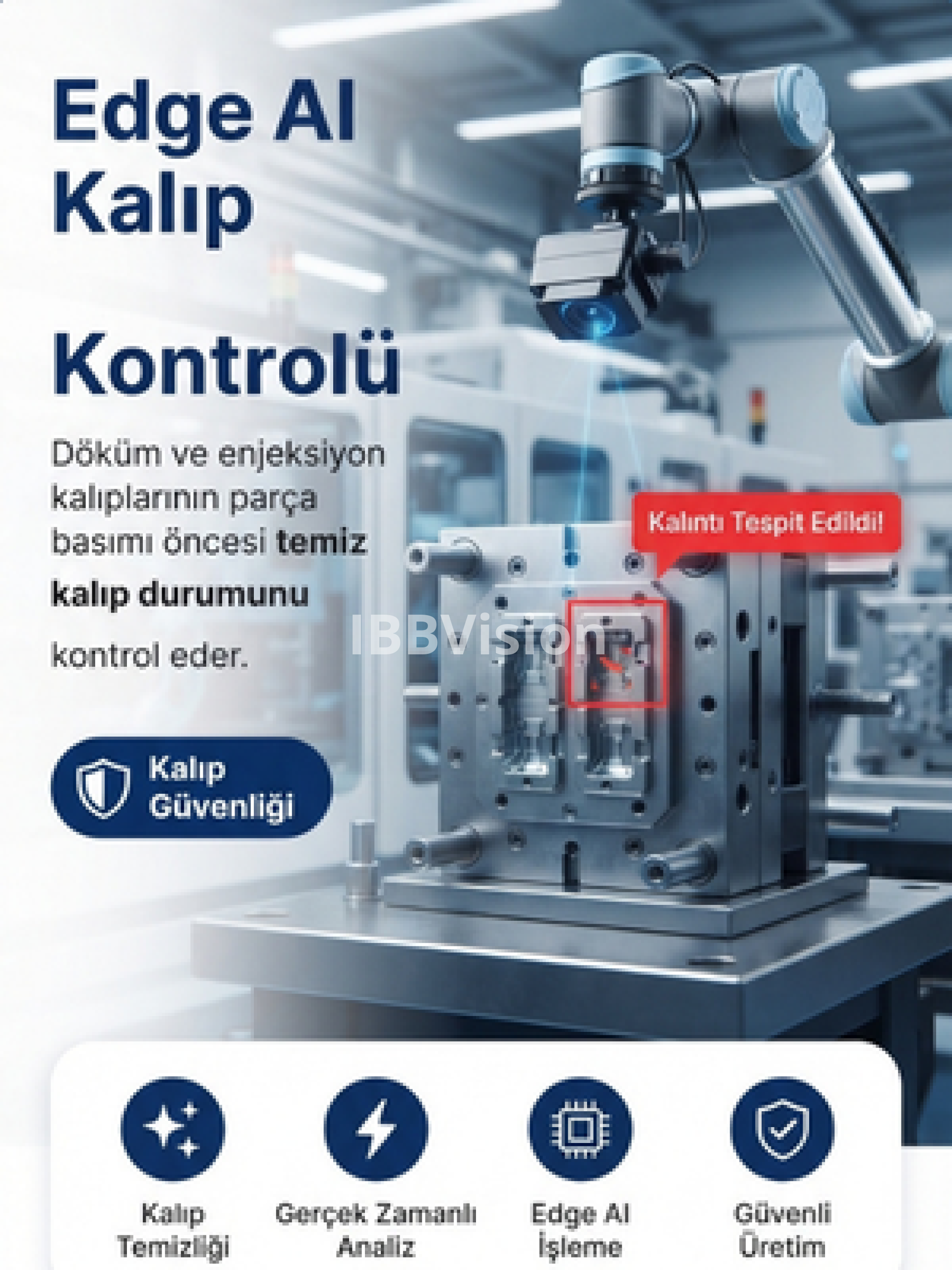
EVA-IND-MOLD-C (Industrial Mold Cleanliness Check) is a flagship, deep learning-based Edge Vision Analysis (EVA) industrial mold protection module that verifies within milliseconds, immediately before mold closure and the application of clamping force, that mold surfaces are completely clean and free of parts, runners, or foreign objects left behind from the previous molding cycle in high-pressure die casting (HPDC), plastic injection, and rubber/composite molding presses.
EVA-IND-MOLD-C eliminates the risk of a small part residue, broken ejector pin, or detached runner fragment trapped inside a precision production mold—potentially worth millions of Turkish lira—being crushed under press closing force, damaging or breaking the mold steel, and bringing production to a halt for days. During every cycle, as the mold opens, the module precisely analyzes both the female and male mold halves (core & cavity). As soon as even the smallest residue, incomplete ejector pin retraction, or insert (metal bushing/nut) positioning error is detected, it generates a high-resolution error image (snapshot), marks the residue location, records a timestamp, and sends an emergency mold-close stop (Mold Close Interlock) signal to the press PLC. Fully integrated with the EVC series Edge Vision Computer hardware family, the module is designed to eliminate unplanned mold failures, prevent costly mold maintenance, and maintain maximum press cycle-time efficiency (OEE).
Key Advantages and Capabilities
-
Millisecond-Level Protection Before Mold Closure (Zero-Crush Mold Protection): Scans the internal mold surfaces immediately before the press closing command is issued, detecting:
-
Part and Runner Residue: Immediately detects product parts that have not fully ejected from the mold, broken runner sections, slag, and residual flash.
-
Ejector Pin and Core Position Verification: Checks whether ejector pins have fully retracted and whether movable core slides are in their correct initial positions.
-
Insert and Metal Component Placement Inspection (Overmolding Insert Check): In insert injection applications, verifies that metal bushings, nuts, or electronic components placed inside the mold by a robot or operator are present and correctly seated at the required angle.
-
-
Full Resistance to Mold Release Agents, Vapor, and Lighting Variations: Unlike conventional pixel-difference (pixel-diff) methods, deep learning models filter out misleading conditions caused by mold release spray vapor, oil reflections, high temperature fluctuations, and metallic surface reflections in casting and injection environments. This minimizes false stops.
-
Simultaneous Dual-Side Inspection (Female and Male Mold): Uses single- or dual-camera optical inspection stations positioned between the mold halves to inspect both the stationary female (cavity) and moving male (core) mold halves within a single cycle without data loss.
-
High-Speed Analysis Without Cycle-Time Penalties: Operates in full synchronization with mold opening and part ejection, transmitting the OK/NOK decision to the press controller without adding any delay to the production cycle time.
-
Cavity-Based Failure Analytics and Predictive Maintenance: In multi-cavity molds, reports with timestamps which cavities repeatedly experience part sticking or residue problems. It also provides predictive maintenance insights for mold cooling channels, ejector mechanisms, and mold release spray nozzles.
-
Zero Cloud Dependency and Uninterrupted Edge AI: Image processing and mold protection algorithms run locally on the EVC (Edge Vision Computer) device directly within the press cell. The system is unaffected by network latency and provides real-time industrial safety interlock response while ensuring complete production data privacy.
Architecture and Industrial Integration Capabilities
EVA-IND-MOLD-C uses the high-performance GPU cores and hardware-based image processing architecture of the EVC hardware family to establish direct hardware-level safety integration with injection molding and die-casting presses.
-
Multi-Press and Multi-Camera Management: A single EVC device can simultaneously protect multiple injection molding or metal die-casting presses across the production floor, managing independent recipes and mold profiles for each press.
-
Industrial Automation and Press Controller Integration: Through EUROMAP 63/67/77 standards, OPC UA, Modbus TCP, PROFINET, REST API, MQTT, and direct fail-safe digital I/O (24V / dry-contact relay safety interlock) interfaces, the module communicates directly with press systems from manufacturers such as Buhler, Frech, Idra, Engel, KraussMaffei, Arburg, and Haitian.
Applications and Industry Use Cases
EVA-IND-MOLD-C is an enterprise-grade industrial mold protection solution designed for all molding facilities where mold costs are high, unplanned downtime causes significant production losses, and high-tonnage press safety is critical:
-
High-Pressure Aluminum / Zamak Die-Casting Facilities (HPDC): Automotive engine blocks, transmission housings, structural cast components, and complex multi-core metal casting molds.
-
Plastic Injection Molding Facilities: High-speed mass-production presses for automotive, home appliance, electronics, and engineering polymer components.
-
Insert Injection (Overmolding) Lines: Precision mold placement applications where metal, cable, or sensor components are encapsulated in plastic.
-
Multi-Cavity Packaging and Cap Molds: High-cycle-time molds with 16, 32, 64, or 96 cavities for caps, preforms, and medical consumables.
-
Rubber, Silicone (LSR), and Composite Press Lines: Molding presses for gaskets, sealing components, and high-precision elastomer products.
Comprehensive Technical Specifications
| Component / Module Feature | Technical Details |
|---|---|
| Module Name | EVA-IND-MOLD-C (Industrial Mold Cleanliness Check / Industrial Mold Cleaning and Part Residue Inspection) |
| Primary Function | Verification of mold cleanliness, residue detection, and ejector/insert positioning before the next molding cycle in casting and injection molds |
| Detection Technology | Deep Learning, Multi-Region Anomaly Detection, and Precision Reference Mold Comparison |
| Detected Risks | Part/Runner Residue, Stuck Flash, Ejector Pin/Core Not Fully Retracted, Missing or Incorrectly Positioned Inserts |
| Application Area | Mold Safety (Mold Protection), Industrial Quality Inspection, and Press Automation |
| Input Data | High-Resolution Industrial IP / GigE Vision / RTSP Stream (Compatible with Global Shutter Cameras and High-Temperature/Dust-Resistant Environments) |
| Outputs and Actions | Instant Press Mold-Close Stop Signal (Interlock), Error Image (Snapshot), Cavity-Based Error Log, HMI Alarm |
| Response / Processing Time | < 40 ms (Compatible with real-time hardware safety interlock triggering before the press closing command) |
| Hardware Compatibility | All Edge Vision Computer hardware models in the EVC-04, EVC-08, EVC-16, EVC-24, EVC-32, EVC-40, EVC-48, EVC-56, and EVC-64 series |
| Operating Architecture | Edge AI (100% local, real-time image processing on the EVC device installed within the press cell) |
| Software Integration | Fully integrated with the embedded EVC Runtime software and the EVA (Edge Vision Analysis) ecosystem |
| Industrial Protocols | EUROMAP 63/67/77, OPC UA, Modbus TCP, PROFINET, REST API, MQTT, and Fail-Safe Digital I/O (24V / Dry Contact) |
| Operating System Support | Windows 11 Pro for Workstations / Ubuntu LTS (on EVC Runtime) |
| Shop Location |