English
 Türkçe
 Русский

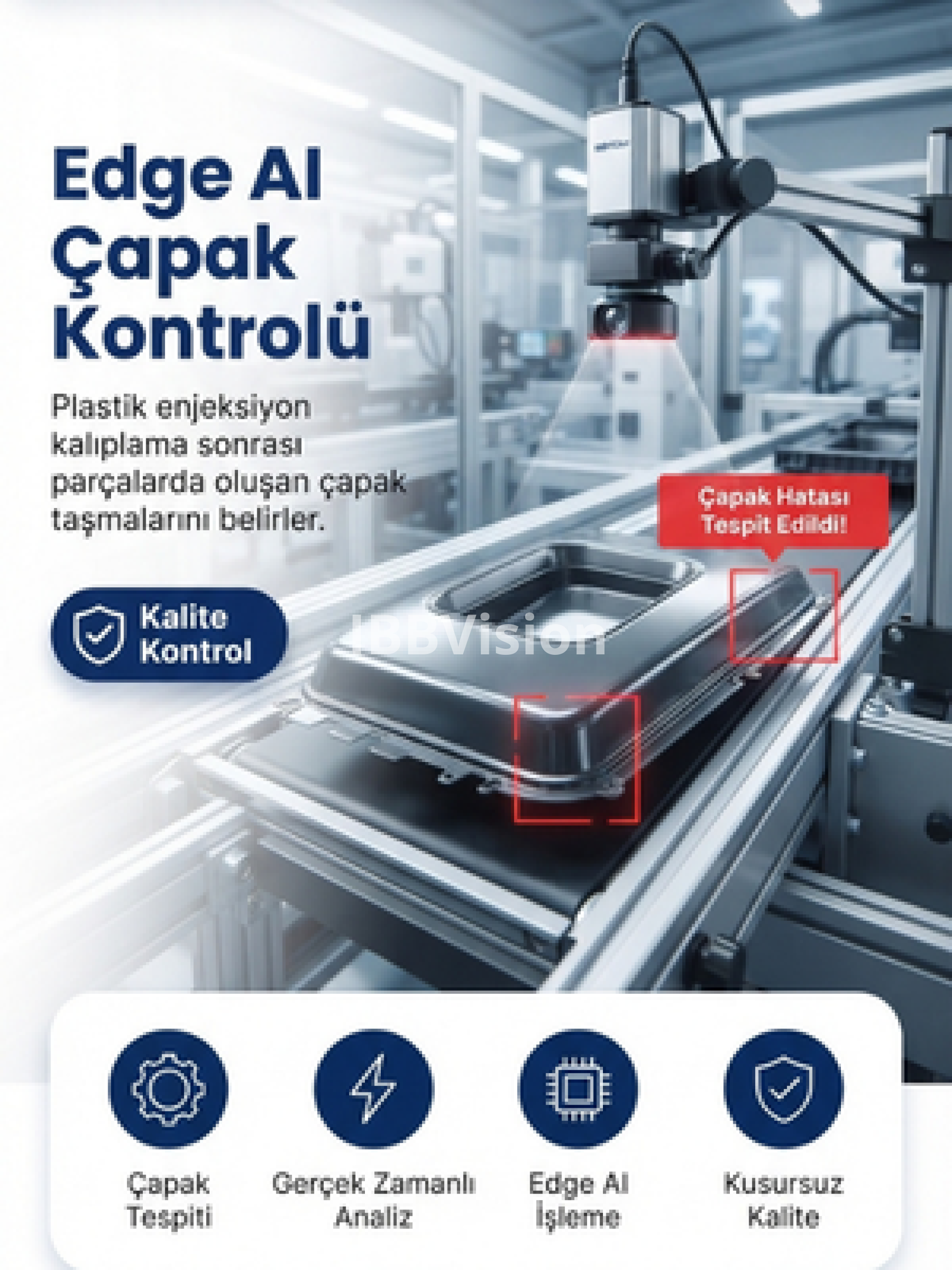
EVA-IND-INJ-FL | Edge AI Industrial Plastic Injection Flash Detection
EVA-IND-INJ-FL (Industrial Plastic Injection Flash Detection) is a flagship-class, deep learning-based Edge Vision Analysis (EVA) industrial quality inspection module that detects flash/burr overflow, parting line flash, and dimensional or geometric deformations in injection-molded parts within milliseconds, with micron-level precision.
Eliminating the high false rejection rates associated with conventional optical gauges and rule-based image processing algorithms when dealing with complex part geometries, reflective or matte polymer surfaces, and minor positional shifts on conveyors, EVA-IND-INJ-FL compares the external contours and critical hole/channel edges of every molded part against reference CAD/Master geometry using deep learning-based segmentation models. As soon as flash exceeding the defined tolerances is detected, it generates a high-resolution defect image (snapshot), marks the precise defect location, and records a timestamp. It then sends an instant trigger signal to the injection molding press, robotic arm (pick-and-place), or rejector mechanism. Fully integrated with the EVC series Edge Vision Computer hardware family, this module is designed to prevent component incompatibilities on assembly lines, reduce secondary manual deflashing operations, and meet automotive and medical quality standards (IATF 16949 / ISO 13485) with a Zero-Defect approach.
Key Advantages and Capabilities
-
Sub-Pixel Contour and Parting Line Analysis: Uses deep learning models to accurately detect millimeter-scale polymer flash along the external perimeter, mold parting lines, ejector pin locations, and internal hole/channel edges:
-
Edge and Parting Line Flash: Detects external contour overflow caused by insufficient mold clamping pressure or mold wear.
-
Hole / Slot Flash: Identifies thin membranes and residual flash inside holes intended for assembly pins or screws.
-
Short Shot and Deformation Inspection: Simultaneously detects incomplete edges and corner defects caused by insufficient material filling in the mold.
-
-
Full Compatibility with Reflective, Transparent, and Dark Polymer Surfaces: Ensures precise edge detection using backlighting and specialized optical analysis algorithms, even with low-contrast black ABS/PP components, light refraction in transparent polycarbonate (PC) parts, and reflective surfaces.
-
Robot Arm (Pick-and-Place) and Conveyor Synchronization: Dynamically aligns the component's orientation and position as it passes in front of the camera during transfer by a six-axis robotic arm or while moving along a conveyor. Defective parts are directed directly into the designated "Defective / Scrap (NOK)" bin.
-
Mold Wear and Predictive Maintenance Analytics: In multi-cavity molds, reports which cavity is producing parts with increasing flash rates and identifies the regions where flash defects are concentrated. It generates early warnings to support mold maintenance and optimization of injection pressure and temperature parameters.
-
Rapid Recipe (SKU) Switching and Few-Shot Learning: When a new mold or component is introduced, the system can complete its learning process within minutes using only a small number of "Good (OK)" sample images, enabling a rapid transition to mass production.
-
Zero Cloud Dependency and Continuous Edge AI Operation: Image processing and geometric analysis run locally and directly on the EVC (Edge Vision Computer) device at the production site. The system is unaffected by network latency, providing industrial real-time response and complete production/design data privacy.
Architecture and Industrial Integration Capabilities
EVA-IND-INJ-FL uses the high-performance GPU cores and hardware-based image processing architecture of the EVC hardware family to operate seamlessly within injection molding cell automation systems.
-
Multi-Cavity and Multi-Angle Camera Support: A single EVC device can inspect parts produced in 4, 8, 16, or 32-cavity molds during the same molding cycle, either in a single frame or through simultaneous multi-camera views, generating independent OK/NOK decisions for each cavity.
-
Industrial Automation, Robotics, and MES / SCADA Integration: Through EUROMAP 63/67/77 interfaces, OPC UA, Modbus TCP, PROFINET, REST API, MQTT, and high-speed digital I/O outputs (24V / dry-contact relay), the module communicates directly with injection molding machines from manufacturers such as Engel, KraussMaffei, Arburg, and Haitian, KUKA/ABB/Fanuc robot controllers, and factory MES/SCADA systems.
Applications and Industry Use Cases
EVA-IND-INJ-FL is an enterprise-grade industrial quality inspection solution designed for all plastic injection molding and polymer processing facilities where dimensional precision, assembly compatibility, and Zero-Defect production discipline are critical:
-
Automotive Suppliers (Tier-1 / Tier-2): Interior trim components, clips, connector housings, sensor enclosures, air ducts, and sealing-critical cover/gasket components.
-
Medical and Pharmaceutical Packaging Manufacturing: Syringe bodies, IV valves, inhaler components, laboratory consumables, and sterilization caps.
-
Home Appliances and Small Household Electronics: Gear mechanisms, buttons and panel components, water/air connectors, and housing components.
-
Electrical, Electronics, and Connector Industry: Multi-pin socket housings, fuse boxes, cable glands, and precision insulation components.
-
Packaging and Cap Manufacturing: Food and beverage caps, flip-top hinged closures, cosmetic packaging components, and thin-wall containers.
Comprehensive Technical Specifications
| Component / Module Feature | Technical Details |
|---|---|
| Module Name | EVA-IND-INJ-FL (Industrial Plastic Injection Flash Detection) |
| Primary Function | Detection of flash overflow and contour defects in parts after plastic injection molding |
| Detection Technology | Deep Learning, Sub-Pixel Contour Segmentation, and Dynamic Master Comparison |
| Detectable Defect Types | Parting Line Flash, Internal Hole/Channel Membrane Flash, Short Shot, Edge Deformation |
| Application Area | Industrial Quality Control (Machine Vision), Plastic Injection Molding, and Robotic Cell Automation |
| Input Data | High-Resolution Industrial IP / GigE Vision / RTSP Stream (Global Shutter and Backlight Compatible) |
| Outputs and Actions | Instant PLC / Robot OK-NOK Signal, Defect Image (Snapshot), Cavity-Based Defect Report, HMI Screen |
| Response / Processing Time | < 50 ms (Fully synchronized decision-making with injection molding cycle times and robot pick-and-place speeds) |
| Hardware Compatibility | All Edge Vision Computer hardware models in the EVC-04, EVC-08, EVC-16, EVC-24, EVC-32, EVC-40, EVC-48, EVC-56, and EVC-64 series |
| Operating Architecture | Edge AI (100% local, real-time image processing directly on the EVC device within the production cell) |
| Software Integration | Fully integrated with the embedded EVC Runtime software and the EVA (Edge Vision Analysis) ecosystem |
| Industrial Protocols | OPC UA, Modbus TCP, PROFINET, REST API, MQTT, WebSocket, and Digital I/O (24V / Dry-Contact Relay) |
| Operating System Support | Windows 11 Pro for Workstations / Ubuntu LTS (on EVC Runtime) |
| Shop Location |